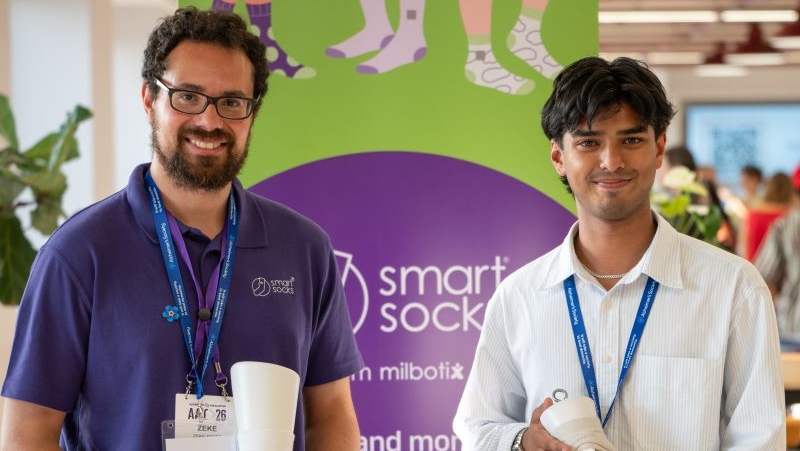
 As part of the SmartSocks®DISCOVERY Pioneers Competition, we are showcasing researchers whose work is exploring new ways wearable technology can support real-world, person-centred health research.
In this post, we meet Beatriz Venâncio, a researcher at the Royal Holloway, University of London whose work sits at the intersection of sleep science, mental health and chronic illness. Her project investigates whether SmartSocks® can provide a comfortable, low-burden way to monitor sleep physiology at home in children and young people living with Type 1 diabetes. By focusing on night-time experiences and daily wellbeing, her research aims to improve understanding of how sleep disruption affects young people with T1D and their families, without adding to an already heavy technological burden.
What is your main area of research?
My research sits at the intersection of sleep science, psychopathology, and chronic health conditions, with a particular focus on children and young people living with Type 1 diabetes (T1D).
How would you describe your research to someone outside your field?
I explore how living with T1D may affect young people and their families beyond medical management, focusing on sleep, mental health, and daily wellbeing. Diabetes does not stop at bedtime, and night-time disruptions can shape how children and families feel, function, and cope the following day. My research aims to capture these experiences and use them to improve support for families.
What originally drew you to this area of research?
I have always been drawn to sleep science and its associations with other conditions During my master’s degree, I had the opportunity to explore this area in more depth, which ultimately led me to pursue it further at PhD level. Working closely with my supervisory team, we developed a project that is not only scientifically engaging and highly relevant but also has strong potential to create meaningful real-world impact.
Who else is involved in your research group or project?
My amazing supervisory team: Dr Alice M. Gregory, Dr Jakke Tamminen, and Dr Juan José Madrid-Valero; and I am sure the remaining members of the Sleep Lab, Dr Rebecca Crowley (Postdoc) and Kirsty Vant (PhD student) are also excited to explore this new technology!
What research question or problem are you investigating through the Pioneers Competition?
Sleep disruption is common in young people with T1D, yet monitoring sleep can add to an already heavy technological burden. Through the Pioneers Competition, we will investigate whether SmartSocks® offer a comfortable, low-burden way to monitor sleep physiology at home, without disrupting routines or adding more visible wearables.
Why is this research important, and who could it ultimately benefit?
By identifying low-burden ways to monitor sleep, this work can support more holistic research and care. Ultimately, it could benefit young people living with T1D, their families, and clinicians by improving understanding of how night-time experiences shape daily wellbeing and health outcomes.
What appealed to you about using SmartSocks®DISCOVERY for this project?
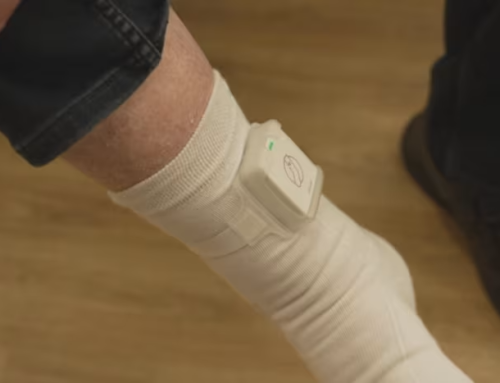
The SmartSocks® seem to offer a way to monitor sleep while minimising disruption and discomfort for participants. Because they resemble everyday clothing, require almost no behaviour change, and can be worn alongside existing diabetes technologies, the SmartSocks® may be particularly well suited for overnight use in young people with T1D.
This project will also give us the opportunity to compare this technology with other well-established methodologies.
Are there any features of SmartSocks® that you’re especially excited to explore?
I am particularly excited to explore the movement data captured by SmartSocks®, as it offers valuable insights into rest-activity patterns during sleep. However, the central focus of this project is tolerability, understanding whether young people are comfortable wearing the socks overnight and willing to use them consistently in real-world settings.
How could your findings influence future research, care, or clinical practice?
If shown to be acceptable and feasible, this approach could enable larger studies using low-burden sleep monitoring. Long-term, it may inform more holistic research and care by integrating sleep into routine understanding of diabetes management and wellbeing.
When you’re not researching, how do you like to spend your time?
When I am not researching (or resting), you will usually find me outdoors! I love hiking, swimming, exploring new places, or simply spending time in nature. I also love reading, especially dystopian fiction.