
SmartSocks®DISCOVERY
Real-time physiological data capture for researchers
SmartSocks®DISCOVERY is a physiological and movement data capture solution for research.
It uses sensor-instrumented (smart) socks to capture pulse rate, pulse rate variability, skin temperature, electrodermal activity, and movement/gait data.
SmartSocks®DISCOVERY is a one-time purchase with no monthly subscription fees.
The challenge
Wrist-worn devices don’t suit every participant
SmartSocks®DISCOVERY simplifies the collection of objective physiological, activity and gait data, and is designed to overcome barriers some research participants face when using conventional wrist-worn wearable devices.
The socks have evidenced tolerability for people living with advanced dementia: Read the full paper here
The solution
What is SmartSocks®DISCOVERY?
SmartSocks®DISCOVERY is a physical and physiological data collection platform for researchers studying aspects of human and brain health.
Developed with support from Alzheimer’s Society, the UK’s leading dementia charity, it gathers real-time data on pulse rate and pulse rate variability, electrodermal activity, skin temperature, and movement and gait.
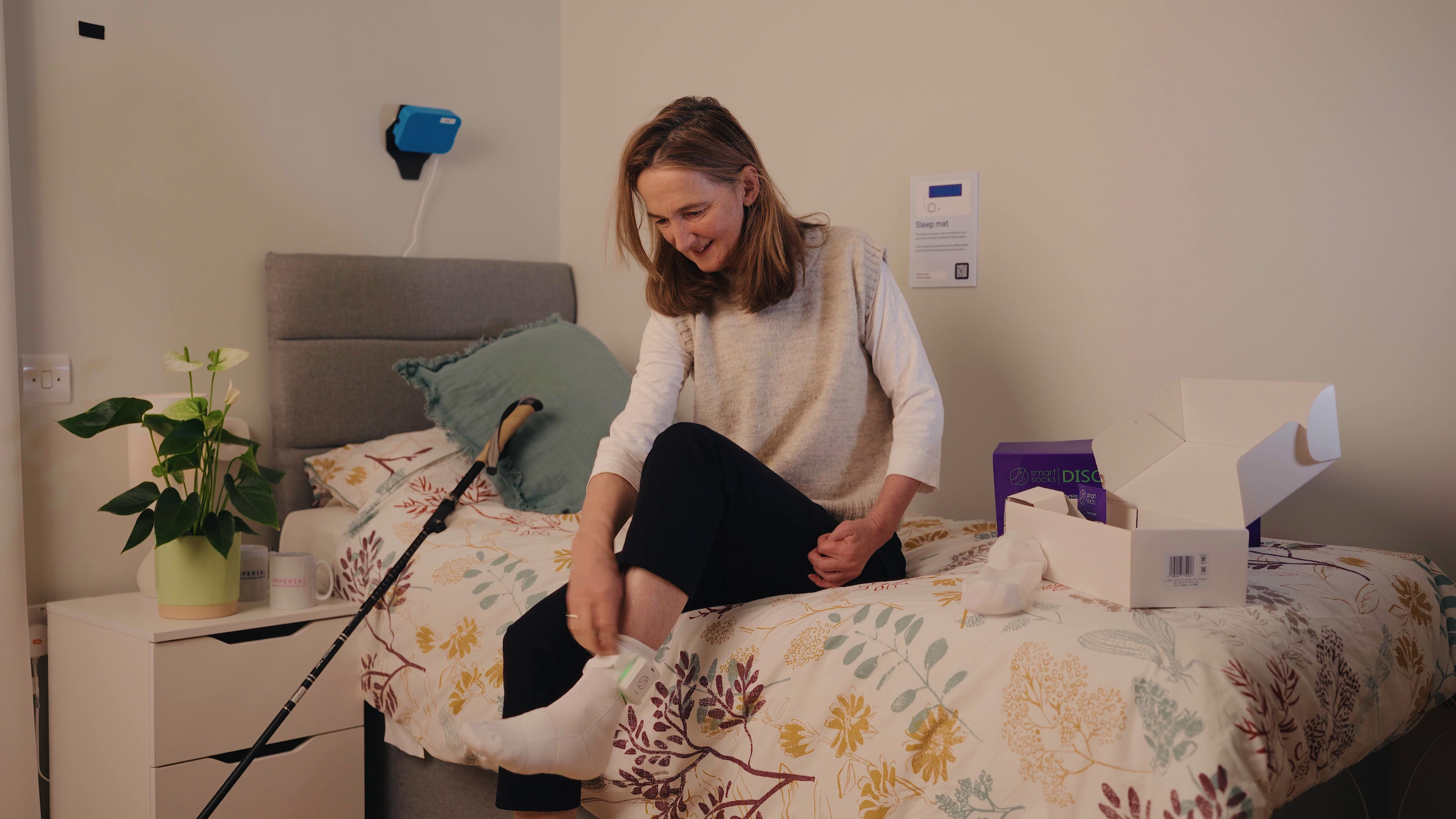
Research Applications
SmartSocks®DISCOVERY supports research across a wide range of domains:
See it in action
SmartSocks®DISCOVERY in action
Video 1: SmartSocks®DISCOVERY explained: how the platform captures physiological and movement data for research.
Video 2: Case study: Dr Luigi Moretti, University of the West of England, on using SmartSocks®DISCOVERY in his research.
How it works
From sensor to data
The active sock in each pair incorporates a sensor unit that gathers real-time physiological and movement data. The data is transmitted over Wi-Fi and displayed on the SmartSocks®DISCOVERY dashboard.
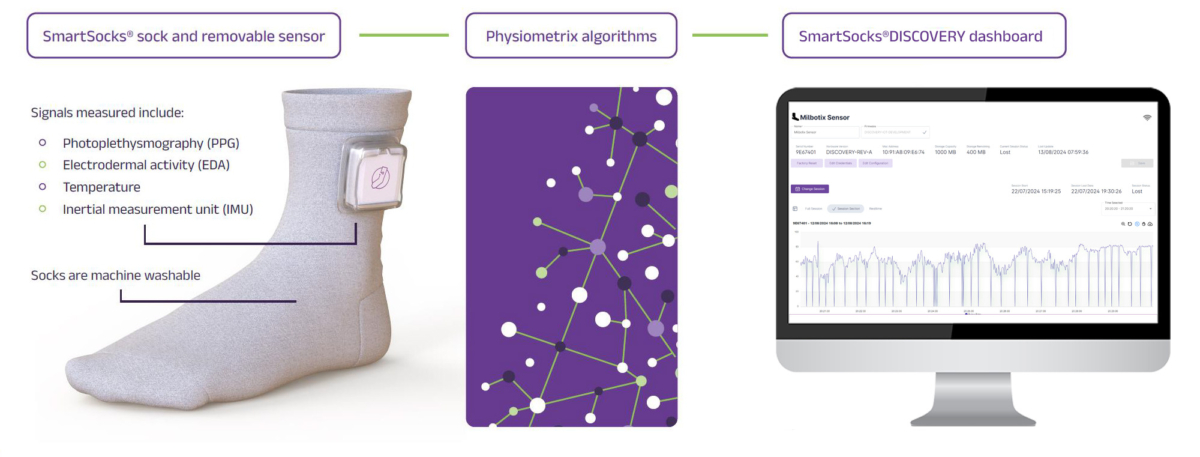
THE DASHBOARD
Your data in the SmartSocks®DISCOVERY dashboard
Data is grouped into Physiological data and movement data tabs, with gait parameters shown as a session summary or stride by stride
Your sensors
View the list of sensors associated with the research team
Live and historic data
Click on a sensor to view live status information and recall historic data sessions.
Visualise and export
Sensor data are visualised in real time and can be exported to a CSV file.
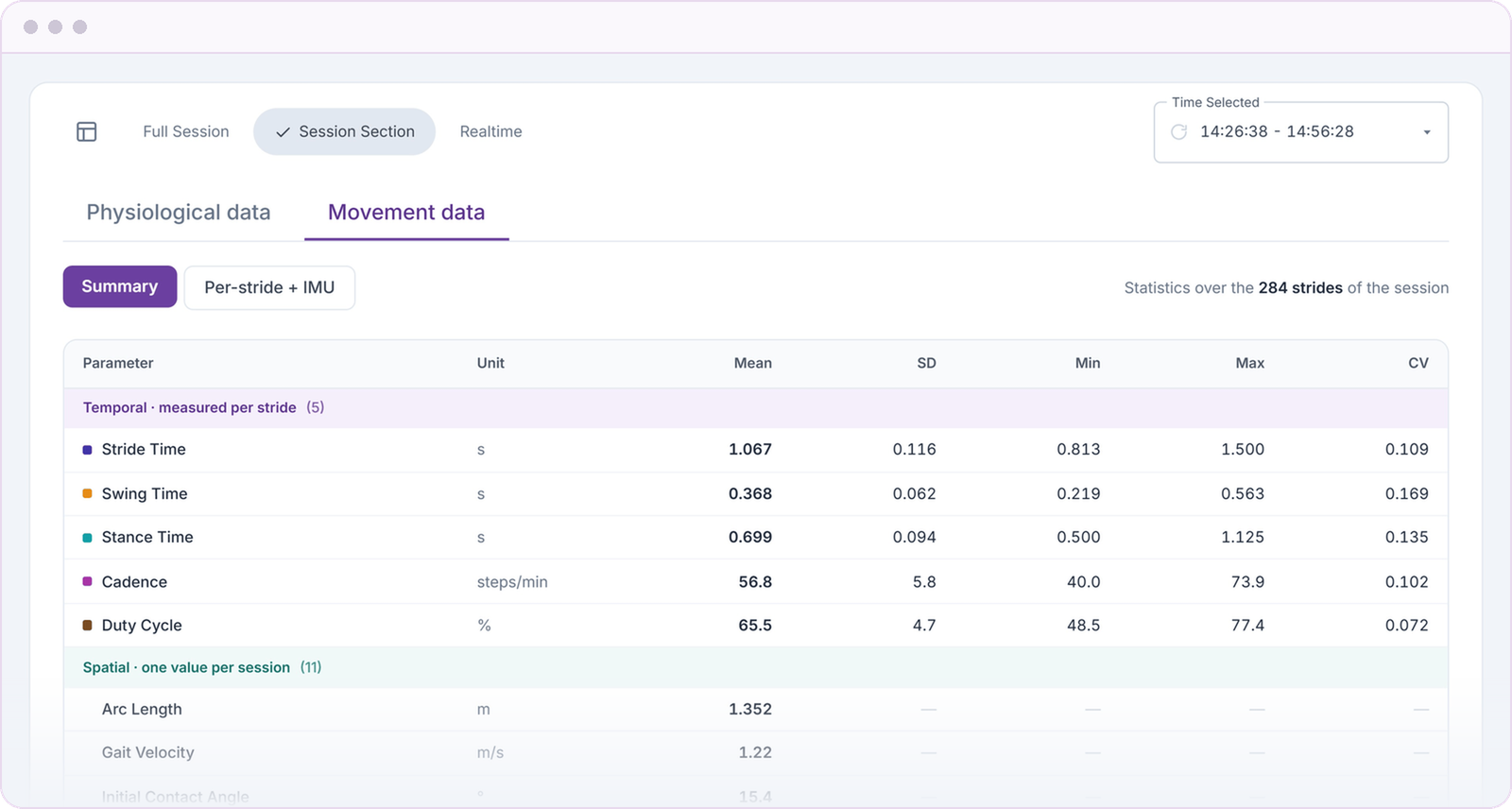
Summary: statistics for each gait parameter over the selected session
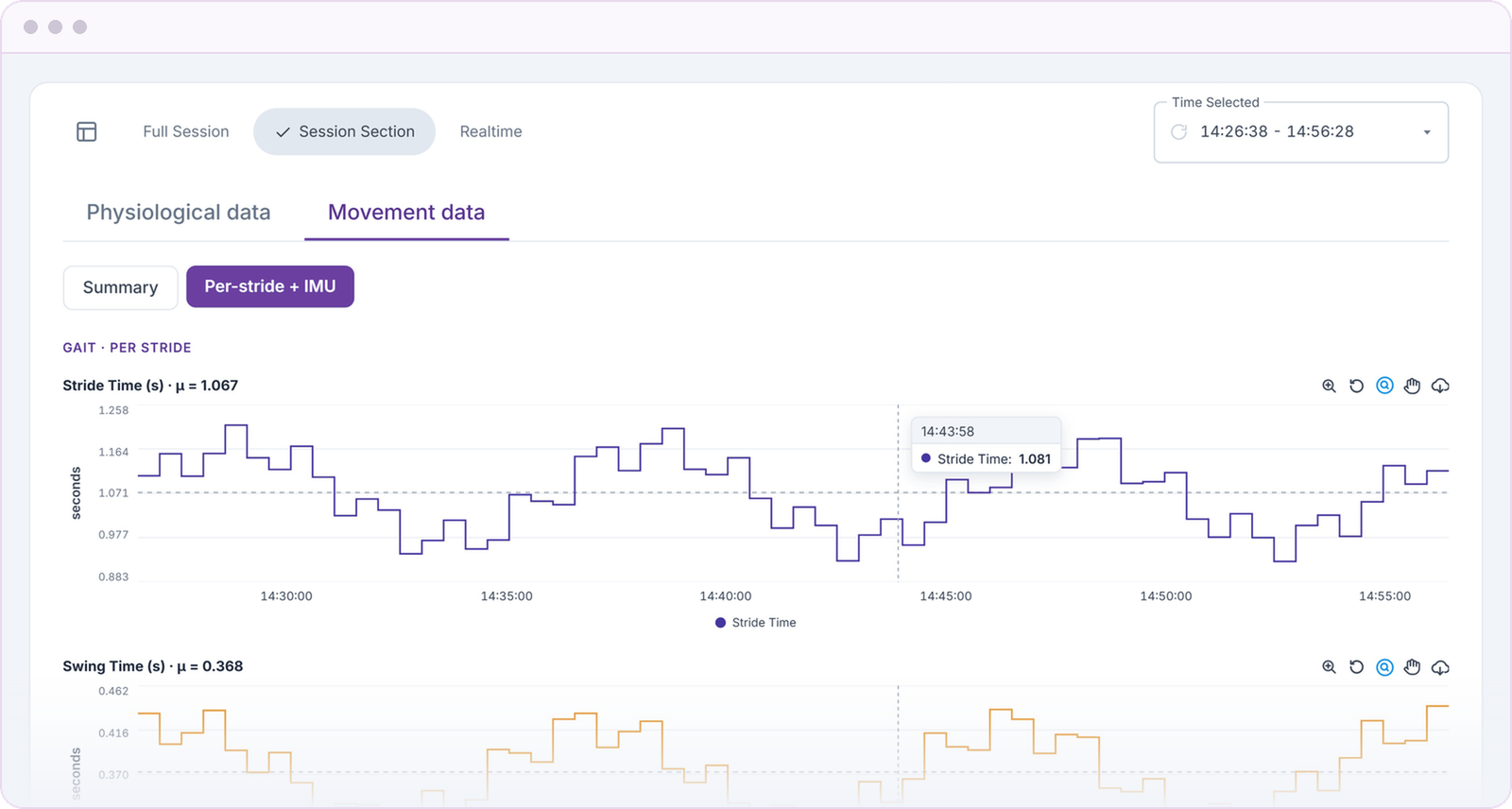
Per-stride + IMU: gait parameters stride by stride, with raw movement and sensor data
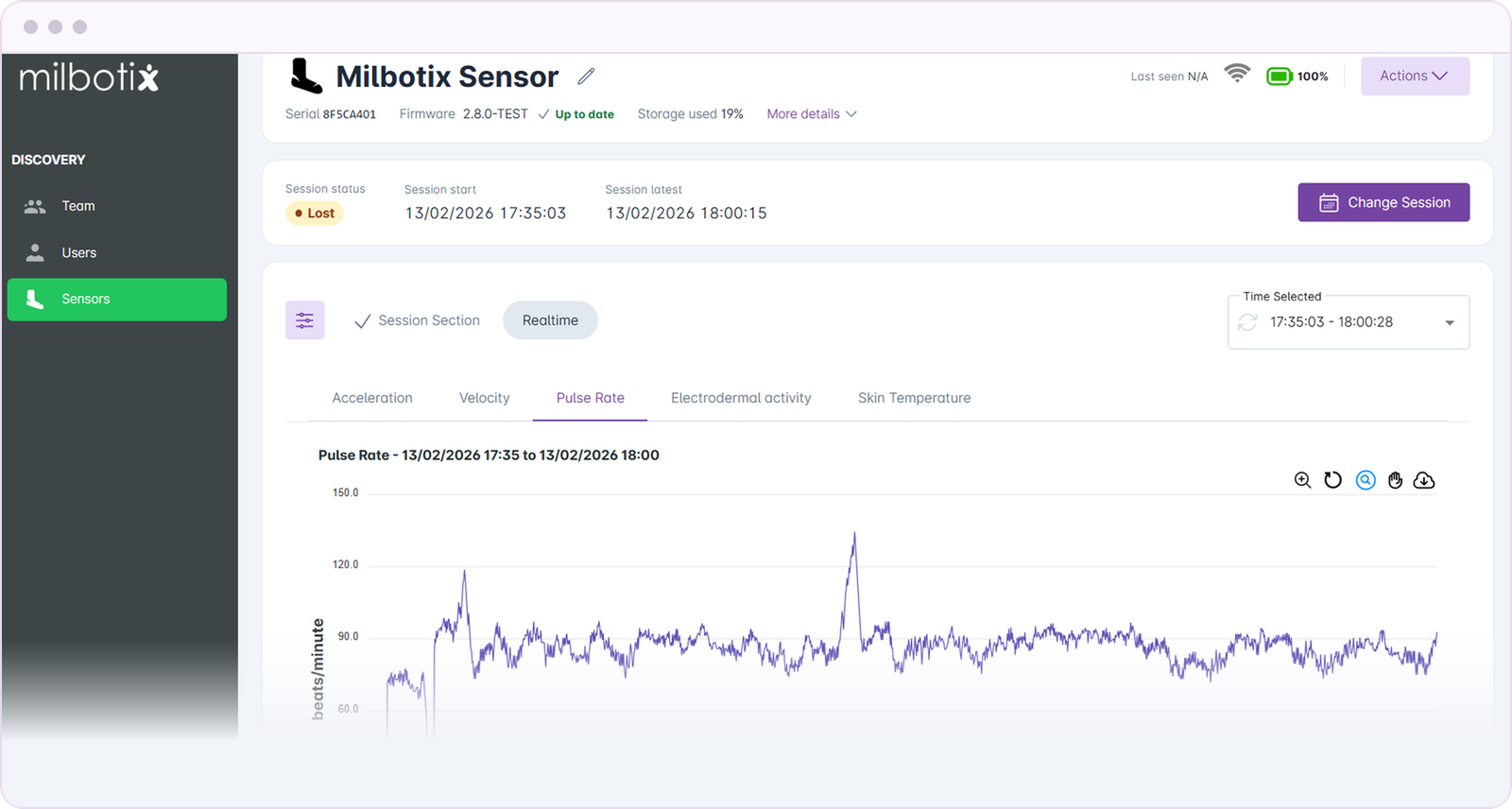
Sensor view: live sensor status, session details and physiological data such as pulse rate
GAIT ANALYSIS
16 gait parameters, from January 2027
SmartSocks®DISCOVERY calculates 16 temporal and spatial gait parameters from movement data collected by the socks, shown in the dashboard alongside raw IMU data.
Milbotix developed and validated the gait analysis algorithms in collaboration with the University of Bath and Brunel University of London.
PIONEERS COMPETITION 2026
Apply for the SmartSocks®DISCOVERY Pioneers Competition
Applicants may come from the health sciences, engineering, computer science, psychology or a related discipline, anywhere in the world. Collaborative entries are welcome. Projects must be original, use SmartSocks®DISCOVERY, and be achievable within 12 months.
WHY SMARTSOCKS®DISCOVERY
The value to your research
SmartSocks®DISCOVERY has significant advantages over alternative data collection methodologies.
EVIDENCE
Evaluated in research settings
Our research partners

KEY FEATURES
Technical specification
SmartSocks®DISCOVERY includes the following key features
Ordering
SmartSocks®DISCOVERY kits
SmartSocks®DISCOVERY is sold as a kit comprising machine-washable pairs of SmartSocks®, removable sensors for continuous data collection, a USB-C charger and a laundry bag.


SmartSocks®DISCOVERY is available in two sizes — XS (UK3–5) and MM (UK9–11) — in white and grey.
SmartSocks®DISCOVERY is not a medical device. The Sensor, Charger, Socks and Dashboard are not intended for use as medical devices or to replace medical devices. They do not and are not intended to diagnose, treat, prevent, alleviate or monitor disease, injury or disability or investigate, replace or modify the anatomy or any physiological process.
Frequently Asked Questions

- Take the sensor off the charger.
- Wait a few seconds until the green LED on the base of the sensor turns on and then off again.
- Put the sensor back on the charger. The LED will flash white while it starts up, then turn solid blue.
Solid blue means the sensor is in setup mode and broadcasting its SmartSocks hotspot.
The sensor is fully charged and has gone to sleep. Lift it off the charger and place it back on to wake it up.
Give it up to 30 seconds to start collecting data. If the LED still isn’t flashing green (or green/blue), put the sensor back on the charger, then insert it into the sock again.
The hotspot is only available while the sensor is in setup mode. Check that the LED is solid blue. If it isn’t, follow the steps in “How do I put the sensor into setup mode?”
The list only shows the five strongest networks in range. If yours isn’t there, you can type the network name in manually.
No. The sensor has 1 GB of built-in storage and keeps recording when it’s out of Wi-Fi range. Stored data is uploaded automatically once it reconnects. You’ll see the LED flash blue while this happens.
They are the three axes of the sensor’s motion unit, fixed relative to the sensor as it sits in the sock.
X runs vertically along the leg (–X points down towards the foot). Y runs horizontally across the face of the sensor. Z points straight out from the face of the sensor.
Linear acceleration is measured along each axis; angular velocity is the rate of rotation around each axis.
Data is sent over Wi-Fi to the SmartSocks®DISCOVERY dashboard, where you can check sensor status, view your data and download it as a CSV file. An API is also available if you want to pull data into your own software.
A full charge takes around 8 hours and gives over 14 hours of use.
Yes. Remove the sensor first, then machine wash the socks at 30°C. The sensor is water-resistant but should not go in the washing machine.
SmartSocks®DISCOVERY comes in two sizes, S (UK 3–6) and M/L (UK 7–11), in white or grey.
Yes. You can download the UKCA and EU Declarations of Conformity from the Documentation section on this page.
DISCOVERY is a research kit. It gives researchers direct access to raw physiological and movement data, without any interpretation or alerts.
COMFORT is a care product currently in development. It is designed to alert caregivers to changes in wellbeing, and uses a sensor around a quarter of the size of the DISCOVERY sensor.

