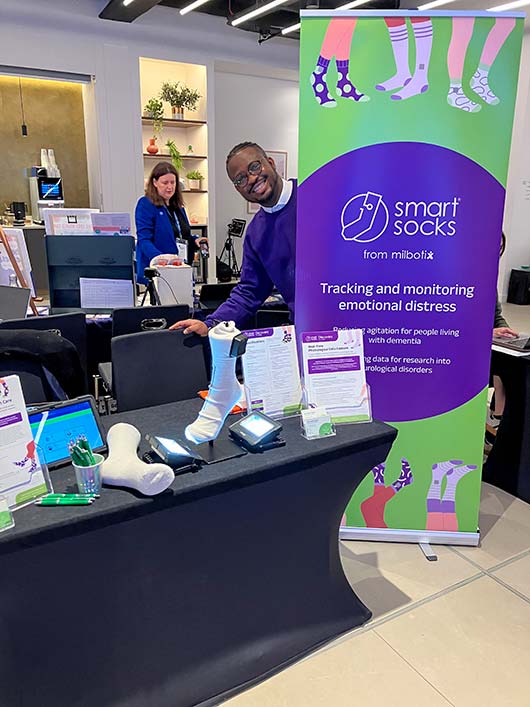
The Story of SmartSocks®
SmartSocks® is an AI-enabled sock wearable device specifically designed to meet the needs of older people by monitoring vital signs, detecting distress, and helping prevent falls. But where did the idea come from?


How it all began
The foundational research began in 2015 after founder Zeke Steer’s great grandmother was placed in a care home when worsening agitation and aggression meant she could no longer be cared for by family. Unmanaged pain and anxiety are recognised triggers for agitation and aggression in Alzheimer’s Disease and other neurological disorders.
Zeke’s research at the Bristol Robotics Laboratory focused on finding a well-tolerated technology-based solution to detect forms of unverbalised distress.
Qualitative research involving frontline care workers was instrumental in identifying a sock as the form factor of choice for people living with dementia. Wrist-worn devices are often removed, can be perceived as stigmatising, and may increase agitation.
During the research, Zeke volunteered at a dementia unit operated by St Monica Trust. There he found that at least half of people diagnosed with dementia experience episodes of agitation and aggression – so called ‘distressed behaviours’.
During the research, Zeke volunteered at a dementia unit operated by St Monica Trust. There he found that at least half of people diagnosed with dementia experience episodes of agitation and aggression – so called ‘distressed behaviours’.
“Zeke’s passion was clear from his first day with us and he worked closely with staff, relatives and residents to better understand the effects and treatment of dementia.”
“We were really impressed at the potential of his assisted technology to predict impending agitation and help alert staff to intervene before it can escalate into distressed behaviours.”
“In the future I hope SmartSocks® will help enable people living with dementia to retain their dignity and have better quality outcomes for their day-to-day life.”
— Fran Ashby, care home manager at Garden House, St Monica Trust
Early findings of the research were exciting enough to secure the backing of Alzheimer’s Society through their Accelerator programme. As the UK’s leading dementia charity, Alzheimer’s Society’s support and investment acted as a catalyst for the commercialisation of the technology.
We are still testing our second product SmartSocks®COMFORT, which will be launched in mid-2026.
“Some people with dementia may present behaviours such as aggression, irritability and resistance to care.”
“This innovative wearable tech is a fantastic, accessible way for staff to better monitor residents’ distress and agitation.”
— Natasha Howard-Murray, Senior Innovator, Alzheimer’s Society
Research
Research continues to be a driving force at Milbotix. Academic collaborations with Brunel University, University of Exeter, Imperial College London, the UK Dementia Research Institute, University of Southampton, University of the West of England and others are providing independent validation of SmartSocks and shedding light on new applications of the technology.
Milestones
2020 | Milbotix founded
2021 | Joined Conception X, the UK’s leading PhD deeptech venture programme
2022 | Recipient of an UnLtd Millenium Award
2022 | Secured investment and support from Alzheimer’s Society through the Accelerator programme
2022 | Medilink South West Award
2022 | Joined SETsquared, ranked as the world’s top business incubator
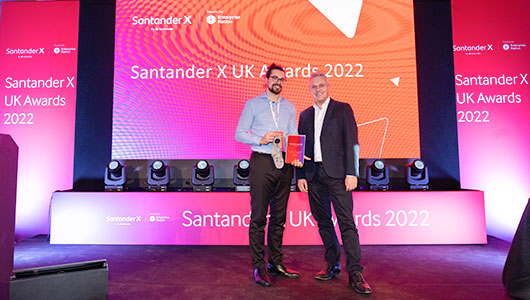
2022 | Santander X UK Awards Accelerate category winner
2023 | Awarded three Innovate UK grants totalling £900k to fund SmartSocks’ development and undertake evaluations in care homes and the community
2023 | Awarded Business Innovation Fund grant from the West of England Combined Authority
2023 | AbilityNet Tech4Good Award winner
2023 | Completed a financing round led by British Design Fund, supported by Two Magnolias, Crowdcube and angels
2024 | Milbotix invited to present SmartSocks research findings at the Alzheimer’s Society International Conference (AAIC), the world’s largest forum for the dementia research community