Socks Over Stigma: Exploring SmartSocks as an Unobtrusive Alternative to Smartwatches for Emotion Monitoring in Anxiety Disorders (MEMoPAD)
 As part of the SmartSocks®DISCOVERY Pioneers Competition, we are showcasing the researchers whose ideas are pushing the boundaries of how wearable technology can be used in health and wellbeing research.
In this post, we meet Luigi Moretti, a researcher at the University of the West of England, whose project Socks Over Stigma explores whether SmartSocks® could offer a less visible, less stigmatising alternative to smartwatches for emotion monitoring in anxiety disorders.
What is your main area of research?
Digital health, more specifically PPIE-shaped affective computing implementations in mental health.
How would you describe your research to someone outside your field?
I’m building a system that helps people with anxiety understand their emotional patterns. We cannot monitor emotions directly, but thanks to wearables we can analyse the body responses that reflect our emotions. Rather than just collecting data, I’m working closely with patients, carers, and clinicians to make sure the technology actually fits into their lives and can be implementable in clinical pathways.
What originally drew you to this area of research?
A mix of personal experience as carer of someone facing mental health challenges, my clinical background as a doctor, and an intuition from a previous startup. In that venture, we used emotion detection for a very different purpose: as an attention hook to keep users engaged. It made me realise how powerful this technology could be. I wanted to redirect it toward something that genuinely helps people.
Who else is involved in your research group or project?
A recent paper published in Nature confirmed the obvious: the happiness of a PhD student is mostly shaped by their supervisory team. My supervisory team -Dr David Western, Dr Michael Loizou, Dr Miles Thompson, and Dr Paul Matthews- is genuinely multidisciplinary, spanning AI and sensing, affective computing, clinical psychology, and mobile app development. Since MEMoPAD is a 6+1 phase co-design project, I can’t forget to mention the patients, carers, and clinicians participating in this journey, sharing their first-hand experiences and feedback. Their enthusiasm and curiosity keep me going! Last but not least, the project wouldn’t be what it is without the generous support of many colleagues, too many to name individually.
What research question are you investigating through the Pioneers Competition?
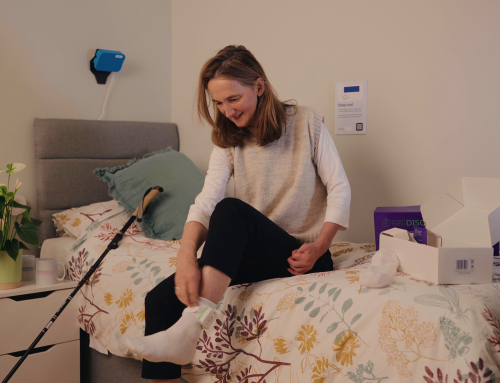
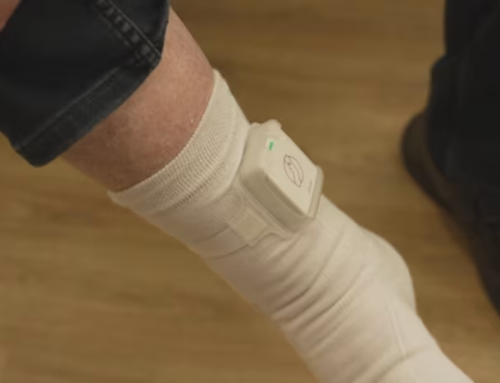
Stigma is a major barrier to wearable adoption in mental health. Smartwatches are visible and can make users feel “marked” as being monitored; which, for people with anxiety, may paradoxically increase anxiety. I’m investigating whether SmartSocks® offer a stigma-reducing alternative: invisible during normal wear, requiring no behaviour change, and occupying a body location rarely associated with health monitoring. Out of sight, out of mind!
Why is this research important, and who could it ultimately benefit?
If SmartSocks® prove acceptable and reliable, they could open emotion monitoring to people who would otherwise reject wearables entirely, improving access to self-management tools and enriching clinical conversations. The findings could also inform how we design future wearables for any condition where stigma is a concern.
What appealed to you about using SmartSocks®DISCOVERY for this project?
The invisibility factor was the main draw since it directly addresses the stigma concerns so common in mental health. But I was also intrigued by the uncommon multi-sensor approach (EDA, PPG, temperature) matching what we’re already collecting from smartwatches. And frankly, it’s a bold form factor that challenges assumptions about where health monitoring “should” happen on the body.
Are there any features of SmartSocks® that you’re especially excited to explore?
I’m most curious about acceptability in daily life: will people actually forget they’re wearing sensors? The “out of sight, out of mind” hypothesis is central to our stigma-reduction argument, and SmartSocks® let us test it empirically. On the technical side, I’m interested in whether foot-based sensors can provide a valid alternative to smartwatches in affective computing.
How could your findings influence future research, care, or clinical practice?
If SmartSocks® prove acceptable and reliable, they could become an alternative form factor, particularly for populations sensitive to visible wearables. For clinical practice, this means more options for patients who refuse smartwatches. For research, it opens longitudinal studies that would otherwise fail due to participant dropout from wearable discomfort or embarrassment.
When you’re not researching, how do you like to spend your time?
Since starting this project, I’ve promised myself to protect my own mental health. I treat free time like any other appointment: fixed in my agenda, whether it’s a scheduled activity or just a moment to breathe. Bristol has an incredible offering -music, art, theatre- and a wonderfully multicultural atmosphere. Apart from that, here, after almost two decades away, I rediscovered capoeira!