 As part of the SmartSocks®DISCOVERY Pioneers Competition, we are highlighting researchers whose work is exploring new ways wearable technology can support health and wellbeing research.
In this post, we meet Tuğba Yeni̇ Erdem, a researcher at Koç University, whose project investigates how skin-based physiological data captured by SmartSocks® can provide deeper insight into patients’ responses during care. Her research focuses on stroke patients, with and without pressure injuries, and examines how these objective physiological signals relate to routine clinical assessments.
What is your main area of research?
My main area of research is patient-centred nursing care with a strong focus on skin sensing, pressure injury prevention, and the integration of wearable technologies into clinical practice, particularly for vulnerable adults.
How would you describe your research to someone outside your field?
I study how the skin can be used as a source of meaningful clinical information. By combining nursing care with skin-based sensing technologies, my research focuses on understanding patients’ physiological responses during care and using this information to support more patient-centred, timely, and personalised clinical decisions.
What originally drew you to this area of research?
My interest in this area grew from my clinical and research experience in pressure injury prevention and skin care. I repeatedly observed that the skin is often treated as a passive surface, while in reality it reflects important physiological changes related to tissue vulnerability, stress, and care quality.
At the same time, I became increasingly interested in how technology could support nursing assessments without replacing clinical judgement. This led me to focus on skin sensing approaches that can complement nursing care, enhance clinical interpretation, and ultimately improve the quality and safety of patient care.
Who else is involved in your research group or project?
This project is carried out with a nursing research team from the Medical Nursing departments. Assistant Professor Meryem Yıldız Ayvaz is part of the team, bringing expertise in critical care nursing, skin physiology, chronic diseases, and cardiac conditions. Assistant Professor Gizem Yağmur Yalçın also contributes to the project with a strong clinical and research background in neurological disorders, particularly multiple sclerosis. In addition, Aleyna Özkan, our PhD student and teaching assistant, is involved in the project as part of her academic and research development. She works closely with the team to strengthen her skills in clinical research, data collection, and technology-supported nursing care.
And of course, our patients and the healthcare professionals who care for them are essential members of the team. Their experiences, collaboration, and feedback actively shape the research and ensure that it remains grounded in real clinical practice.
What research question or problem are you investigating through the Pioneers Competition?
Through the Pioneers Competition, we are investigating how skin-based physiological data captured by SmartSocks can be used to better characterise patients’ responses during care, particularly in stroke patients with and without pressure injuries, and how these objective indicators relate to routine clinical assessments.
Why is this research important, and who could it ultimately benefit?
This research is important because clinical decisions in skin care and pressure injury management are often based on intermittent observation and subjective assessment. Our findings could benefit patients, nurses, and healthcare systems by supporting more informed, consistent, and patient-centred care, especially for individuals who have difficulty communicating their needs.
What appealed to you about using SmartSocks®DISCOVERY for this project?
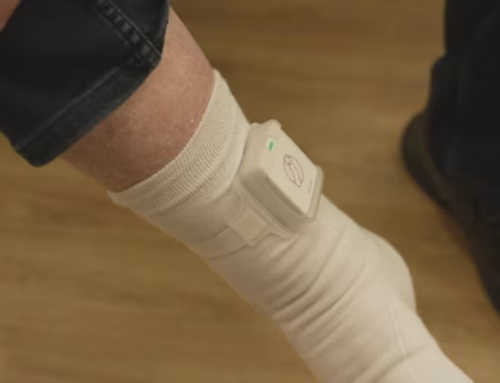
SmartSocks®DISCOVERY appealed to us because it offers a non-invasive and practical way to capture continuous, skin-based physiological data that align well with nursing workflows and real-world clinical settings.
Are there any particular features of SmartSocks® that you’re especially excited to explore?
We are particularly interested in exploring electrodermal activity, skin temperature, and motion-related parameters, and how these signals change during routine nursing care and skin-related interventions.
How could your findings influence future research, care, or clinical practice?
Our findings could support the integration of skin sensing technologies into routine nursing assessments, contribute to more standardised and data-informed skin care practices, and encourage future research on technology-assisted, patient-centred care models.
When you’re not researching, how do you like to spend your time?
Outside of research, I enjoy spending time with my family, travelling, and staying physically active. I especially enjoy dancing, including Lindy Hop and Zumba, which help me stay energised, creative, and balanced alongside my academic and clinical work.